Arts & Culture
Arnold J. Kemp: Whispering Amid the Darkness, Shining in the Light
By TJ Norris
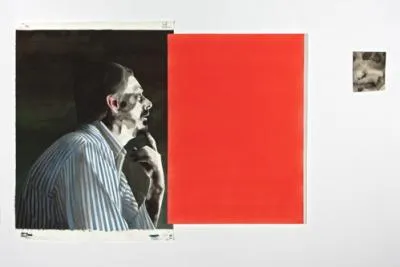
A simple and eloquent tone rises up in a new grouping of work by Arnold J. Kemp—recent Portland transplant and brand-new chair of Pacific Northwest College of Art’s Master of Fine Arts in Visual Studies program.
The title of the exhibition, This Quiet Dust, Ladies and Gentlemen, quotes Emily Dickinson, though for some the reference may be far less literal. The much-anticipated show, his first with PDX Contemporary Art, is on view in the Pearl District during the month of November.
The solo exhibit marks Kemp’s return to Portland after his residency with PICA during 2007’s TBA Festival. With very few African-American artists in our backyard, his voice is heartily welcome, but it’s what he’s saying—and what he’s not—that delivers the buzz beyond the glittery surface. His paintings are more like composites or encounters, employing common materials you may find in a preschool classroom to provoke the sense of the familiar—but instead of a construction-paper slogan reading “I Love Mom” magnetized to the Frigidaire, his compositions are deeply imbued with his own “black experience.” After our discussion, and a closer look at his studio process, that experience can be very broadly defined.
The soft-spoken Kemp recently moved from San Francisco, where he acted in a lauded curatorial role with Yerba Buena Center for the Arts for a decade. Before that time he worked for world-renowned photographer Nan Goldin while living in New York City for a half-dozen years or so. Kemp talks about the culmination of “blackness” as being not only skin deep but also referenced in the roots of punk rock music, and even in the essence of the black arts, or occultist magick. This brings with it a certain framing or embodiment of queerness into light.
As we talk more about his roots it is most interesting to discover the logistic commonalities we readily shared growing up gay punks in Boston in the ’80s and ’90s. He worked in a used camera store in Harvard Square, where I shopped and lived just blocks away. While I was studying at MassArt, Kemp was pursuing his undergraduate degree across the street at the Museum School at Tufts University. We had never met until now, some 20 years later. Learning how music of the era helped to inform his “Daydream Nation” series—the big black stretched linens dotted with plastic googly eyes atop a huge field of shiny black glitter—a vortex, a void, suddenly clicked.
In time Kemp craved a larger sense of critical engagement of his work, its growing penchant for the conceptual paving the way to his inclusion in a pivotal Thelma Golden-curated show entitled Freestyle (2001) at Harlem’s Studio Museum. This was one of the decade’s focal exhibitions showcasing young black artists, and it would have a profound effect on Kemp’s career. It also bridged the artist’s sense of identity with canvases that were sized per his own body height and would eventually become the basis for his graduate thesis at Stanford University.
During our conversation, he mentions Robert Ryman and late great dadaist Marcel Duchamp as key influences. The impact of such modern minimalists fits well into works such as “Cant,” “Descant” and “Recant”—pieces he’s been working out since 2007 using patterns of tiny stick-on doll eyes across bands of pure black Flashe and mixed media. The work stares right back at the viewer, a collective of hundreds gaping like surveillance through a midnight sky.
In This Quiet Dust, Ladies and Gentlemen, the artist has also included a selection of sizable photographic carbon prints titled “(Them)Trees/(Them)Changes,” which he commonly refers to as “prosthetics.” The title makes lyrical reference to the jazz-speak of Duke Ellington, while the ranging field of tree limbs is truncated by the act of cropping. These works seem more personal, less about the surface. There’s something more cinematic here—perhaps about the misgivings of false starts/endings.
The artist discusses the gestural splattering of the world’s most cherished expressionist, Jackson Pollock, but for me the work speaks of the body and its internal circulatory system, passing through the flesh and digging much deeper, revealing another level of a common humanity. In these trees, a disquieting subtext emerges while Kemp spins a lovely web with which to be reckoned.
TJ Norris is an interdiciplinary artist and curator. For more information, please visit www.tjnorris.net.
Arnold J. Kemp’s This Quiet Dust, Ladies and Gentlemen, runs November 3-28 at PDX Contemporary Art, 925 NW Flanders Street, Portland. Hours: 11 a.m.-6 p.m., Tuesday through Saturday, www.pdxcontemporaryart.com